Silver Denarius of Julius Caesar, Africa (47/46 BCE)
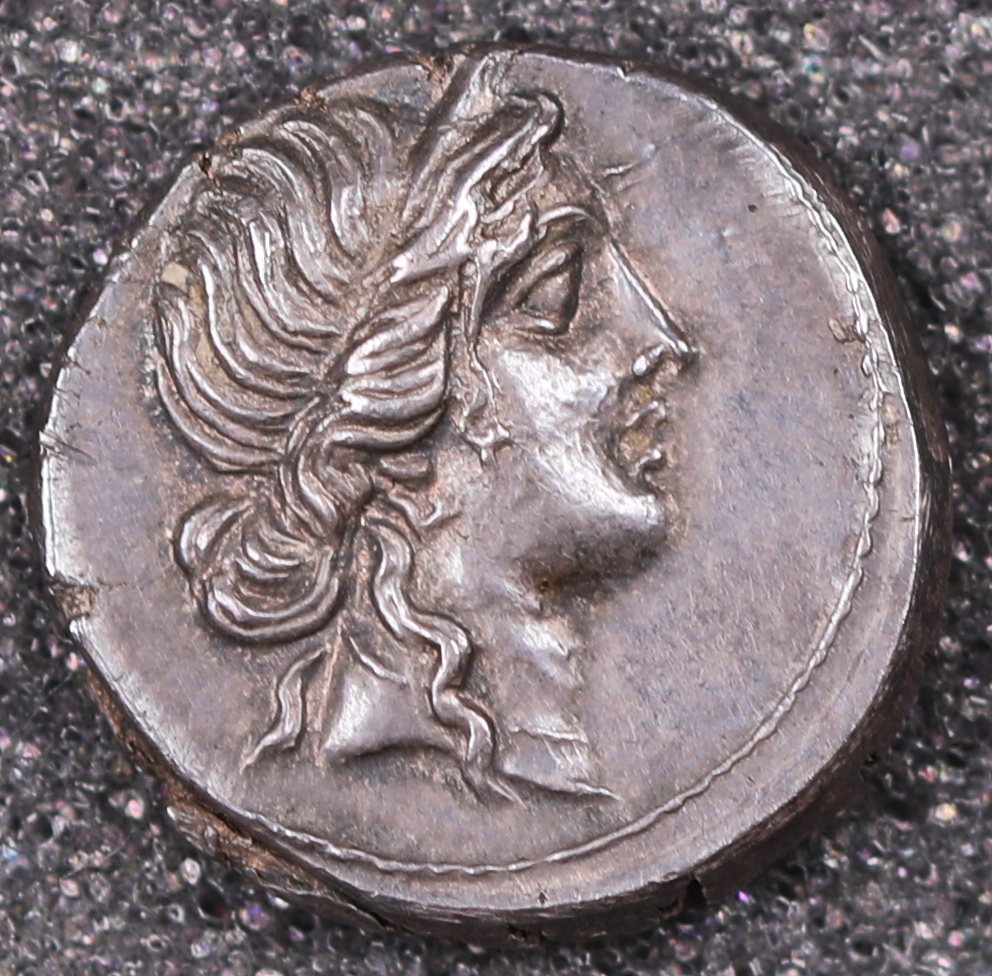
As Julius Caesar came to power as the first century BCE, he asserted his descendance from the goddess Venus and the mythological Trojan prince Aeneas, who were both involved in the founding of Rome. He first proclaimed this in 69 BCE at his aunt’s funeral, and again on coinage in 47/46 BCE as seen here. Imagery of Aeneas solidified the Julian family’s connection to the mythical past and thus Caesar’s claim to power. Venus’ portrait recalls the establishment of the temple of Venus Genetrix in 46 BCE under Julius Caesar. This was the first time the goddess received the epithet “Genetrix,” or mother, further signalling Caesar’s divine heritage through Aeneas. Venus is hailed as the mother of Rome and of Caesar, being used to further his claim to Roman power. Imagery of the goddess as a mother is integrated into his regime, a previously less significant part of her divinity, in order to support Caesar’s rule and the morality of a good Roman matron.